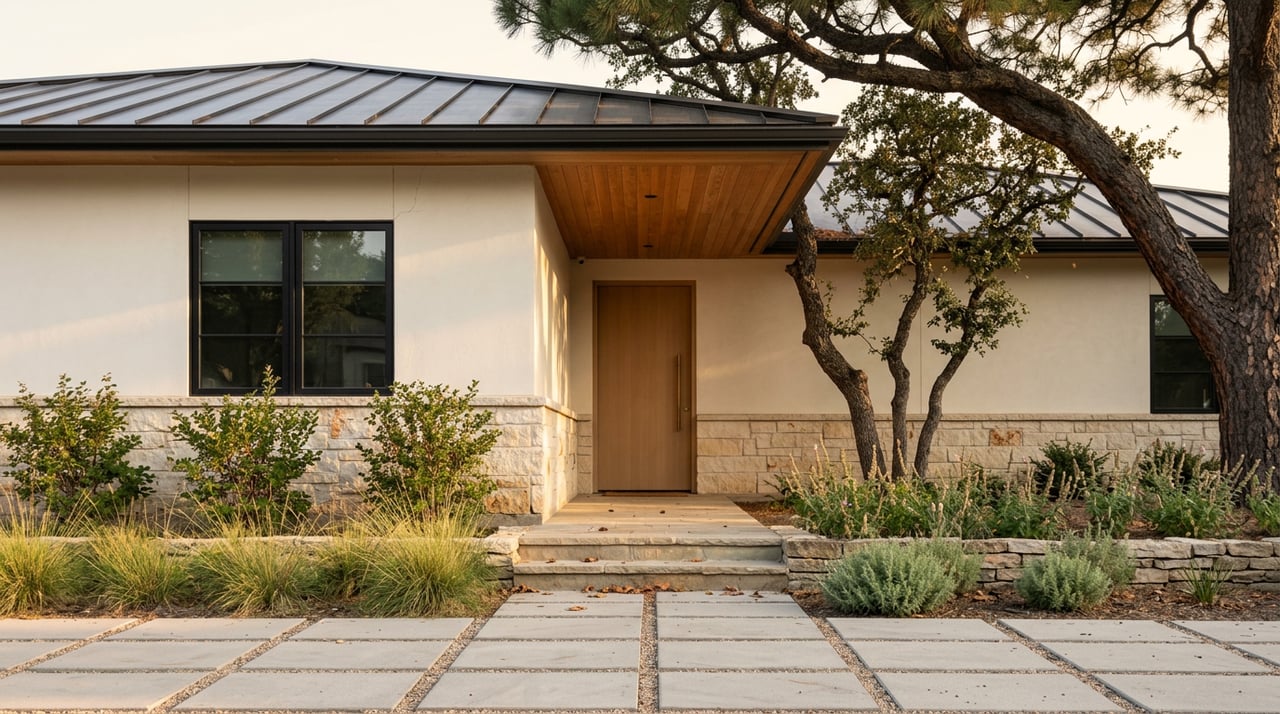
Walk two blocks in Sagamore on a Saturday morning and you will pass houses that look like they were built by the same crew on the same weekend. Same stucco tones, same standing-seam roofs, same young trees still staked to their root balls. Then you notice the fences. One yard has a matte black metal fence that went up within weeks of the frame. The next yard over still has a strip of orange snow fence where a permanent one should be, waiting on paperwork that has nothing to do with the house itself.
That gap is not cosmetic. It is the visible edge of two different governing systems sitting inside the same fire footprint, and it is the first thing a buyer should understand before writing an offer on rebuilt inventory in Superior.
Same fire, two different rulebooks
Every home in Sagamore burned in the Marshall Fire on December 30, 2021. Unlike most Front Range subdivisions, Sagamore was never covered by a homeowners association. It answers to the Town of Superior's own Planned Unit Development regulations, spelled out in the Sagamore Regulations Summary that the town's planning department publishes for exactly this reason. Change the rules in Sagamore, and the town board changes them.
Rock Creek is a different animal. It is a roughly 2,800-home master-planned community with its own Master Homeowners Association and an Architectural Control Committee that reviews every exterior change, fencing included. When Rock Creek lost dozens of homes to the same fire, its rebuilding families answered to their HOA board, not the town.
Neal Shah, who served as Superior's mayor pro tem during the rebuild years, told the Denver Gazette that "Sagamore was effectively ground zero for the Marshall Fire." He was talking about the concentration of destruction, but the phrase applies just as well to the governance question. Sagamore's fire started a conversation with one government body. Rock Creek's started one with an elected homeowner board answerable to its own members first.
The fence fight that shows what the difference actually costs
The clearest evidence of that split played out in fencing, of all things.
Rock Creek's original covenants required six-foot cedar fencing in a shade called Cabot Dune Gray, and fire investigators later pointed to those same wooden fences as fuel that carried flames from yard to yard in minutes. When rebuilding families asked their HOA to approve fire-resistant metal fencing instead, the seven-member Rock Creek Master Homeowners Association board debated the request for more than a year before finally voting, in mid-2023, to allow it. Some board members and residents worried metal fencing would look out of place next to the community's original wood standard. Jen Kaaoush, a Superior town trustee and co-director of the survivor group Superior Rising, told the Denver Gazette she expected the HOA vote to be the easiest hurdle of the whole rebuild, not the hardest.
Sagamore never had that debate, because Sagamore never had an HOA to have it with. Its fencing rules lived inside the town's own PUD language, and the town board could and did amend that language once it decided fire-resistant fencing made sense.
| Sagamore | Rock Creek | |
|---|---|---|
| Governing body | Town of Superior (Planned Unit Development) | Rock Creek Master Homeowners Association |
| Who approves exterior changes | Town planning staff and board | HOA Architectural Control Committee |
| Fencing rule change after the fire | Amended by town board action | Approved by HOA board vote after roughly a year of debate |
| Where a buyer checks the current rules | Town of Superior planning department | HOA governing documents and ACC minutes |
Neither system is better on its face. But they produce different timelines, different appeal processes, and different people a homeowner calls when a fence, a shed, or a solar array needs sign-off five years from now. A buyer comparing a Sagamore rebuild to a Rock Creek rebuild is not just comparing square footage. They are comparing which body gets to say yes or no to the next exterior change they want to make.
The variance that never makes it onto a walkthrough
Governance friction shows up in more than fencing. In March 2025, a new build going up on a Sagamore lot drew complaints from neighboring Marshall Fire survivors who said the house exceeded the neighborhood's height and setback rules. Town officials confirmed the home had received an accessibility accommodation for an elevator that allowed roughly six additional feet of height, and said decisions like that one are made without public input because of federal accessibility and medical privacy law. The remainder of the home met the Sagamore regulations. The homeowner declined to comment publicly.
That story matters to a buyer for a reason that has nothing to do with elevators. Colorado's Seller's Property Disclosure form asks a seller to flag nonconforming uses and zoning variances on the property, but the disclosure is only as good as what that particular seller actually knows. The Colorado Division of Real Estate is explicit that the form covers a seller's current actual knowledge as of the date of the contract, not what a previous owner knew or what a title search would eventually surface. If a rebuilt Sagamore home changes hands once or twice, a variance granted to the original post-fire owner can sit in the town's permit file without ever showing up in a conversation between the current seller and a buyer, because the current seller may genuinely not know it exists.
The fix is not complicated. It means asking your agent to pull the actual building permit file from the town rather than relying on the disclosure form alone, especially on a rebuilt lot where the home's history is only a few years old and every approval was still being worked out in real time.
What the price gap between two rebuilds is actually measuring
Not every rebuilt home in Superior is priced the same way, and the gap is wide enough that it changes how a buyer should read a listing.
New construction on a cleared, burned lot has generally sold for around $600 a square foot, while homes that survived the fire and were remodeled rather than rebuilt from the ground up have traded closer to $450 a square foot, according to a detailed account of the town's recovery published by ColoradoBiz. A full rebuild has typically run $650,000 to $1.1 million, and in the year or two after the fire, cleared, burned lots in Sagamore were listing for $300,000 to $450,000. That gap between what a bare lot sold for and what it cost to actually rebuild is part of why some owners chose to sell rather than start over, and it still shows up today as the spread between a full rebuild and a remodeled original on the same block.
By 2026, most of Sagamore's lots have been rebuilt, but not all of them. Listings for some of the last remaining parcels are still reaching the market this year, and at least one new Toll Brothers home in Superior is scheduled for delivery in summer 2026. A buyer touring the neighborhood today is genuinely looking at a mix of five-year-old rebuilds, homes that were saved and remodeled, and construction that has not finished yet, all within the same few blocks.
That mix also explains something odd in the neighborhood-level pricing data. Superior's median sale price over the three months ending in May 2026 was $967,000, up 17.9% year over year, while a separate estimate of the town's average home value as of June 2026 put that figure closer to $832,000, down slightly from a year earlier. Both numbers can be true at once. A median price built from a run of new-construction rebuild sales will climb faster than a broader value estimate that includes the town's older, untouched housing stock. If your target home is a five-year-old rebuild, the median tells you more. If it is an original pre-fire home, the broader estimate is the closer read.
The flood line nobody mentions on a tour
One more line item catches buyers off guard after closing rather than before it. Some rebuilt parcels in the burn area sit inside a mapped Zone AE flood zone, which can add $1,500 to $4,000 a year in flood insurance on top of a standard homeowner's policy. It is not something that shows up on a walkthrough, and it rarely comes up until a lender orders a flood determination during underwriting. Asking early, before you are three weeks into a contract, saves a renegotiation later.
Before you write an offer on a rebuilt home in Superior
- Confirm which governing body actually controls the lot: the Town of Superior's PUD rules in Sagamore, or a specific HOA's Architectural Control Committee elsewhere in Rock Creek or Coal Creek Ranch.
- Ask your agent to pull the building permit file directly from the town rather than relying only on the Seller's Property Disclosure form.
- Ask whether the home was rebuilt from a cleared lot or remodeled from a structure that survived, since that alone can explain a $150-per-square-foot gap between two similar-looking houses.
- Check whether the parcel falls inside a mapped flood zone before you are deep into your loan underwriting.
- Read the HOA's architectural guidelines and recent meeting minutes if one applies, since board timelines on things like fencing and exterior materials can run well past a year.
FAQ
Does every home in Superior's fire footprint belong to a homeowners association? No. Sagamore has no HOA and answers to the Town of Superior's Planned Unit Development regulations. Rock Creek and several other affected subdivisions do have HOAs with their own architectural review processes.
How do I find out if a specific rebuilt home has an approved zoning variance? The Seller's Property Disclosure form only reflects what the current seller actually knows, which may not include a variance granted to an earlier owner. Pulling the permit history directly from the Town of Superior's planning department is the more reliable step.
Is the Marshall Fire rebuild essentially finished in Superior as of 2026? Largely, yes, but not entirely. Most Sagamore and Rock Creek lots have been rebuilt, though a handful of final lots and at least one new-construction home are still reaching the market this year, which is part of why buyers still encounter a mix of finished rebuilds, remodeled originals, and homes not yet complete.
If you are weighing a rebuilt home against an untouched original in Superior, the paperwork matters as much as the finish level. The Groem Group works this exact footprint regularly and can walk you through a specific property's permit history, governance structure, and pricing logic before you write an offer. Reach out to request a home valuation and a straight read on what a particular Superior address actually comes with.