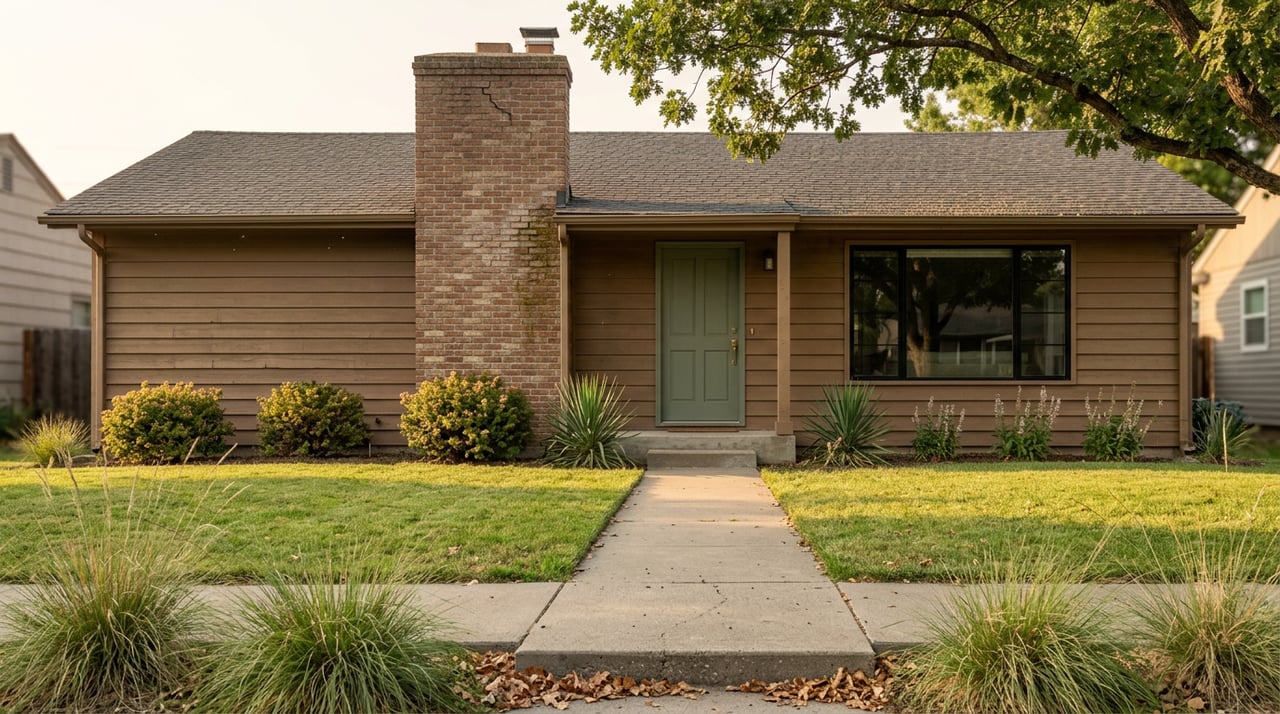
A buyer under contract on a 1978 ranch in North Louisville gets the seller's property disclosure back with the radon section marked "unknown, no test performed." The sewer line section says the same thing. On paper, this reads as neutral. No known defects. Nothing to flag.
It isn't neutral. In Colorado, a seller only has to disclose what they know. If nobody ever tested, there is nothing to know, and nothing to write down. A house that tested at 2 pCi/L and a house that has never been tested in fifty years produce the exact same blank line. The disclosure form cannot tell the buyer which one they're looking at. That gap between "clean" and "untested" is where Louisville buyers lose money after closing, and it shows up most often in the town's older housing stock, not the new-build subdivisions where everything has already been scoped and certified once.
The law requires a warning, not a test
Colorado's radon disclosure statute, Senate Bill 23-206, has been in effect since August 2023, so this is established practice rather than a new wrinkle. It requires every residential sales contract to carry a bold-faced warning recommending a radon test, and it requires the seller to disclose any test results, reports, or mitigation work they know about, along with a copy of the state health department's radon brochure. What it does not require is that the seller test the house before selling it.
Boulder County's own guidance to real estate professionals spells out the practical effect: the seller's property disclosure form lists radon as a hazard that must be disclosed if the seller knows it exists or has ever existed, even if a past test came back under the action level. Knowledge is the trigger, not the presence of the gas. A seller who never ordered a test has complied with the law by writing "unknown." A buyer reading that line as reassurance is reading it wrong.
This matters more in Louisville than in newer Front Range subdivisions because Boulder County carries the EPA's highest radon designation. The county's health department confirms that the EPA has ranked Boulder County as Zone 1, meaning the average house is expected to exceed the 4.0 pCi/L action level. Statewide, the Colorado Department of Public Health and Environment estimates about half of homes test above that threshold, against a national average closer to 1.3 pCi/L. One publicly logged reading from a Boulder home came back at 12.0 pCi/L, three times the action level, which is a single data point rather than a neighborhood average, but it illustrates the range a Zone 1 designation can actually produce in a single basement.
The sewer line has the same blind spot, older and buried
A standard Colorado home inspection is a visual inspection. It does not include running a camera down the sewer line unless the buyer specifically requests it as an add-on, and most don't think to. That means the same asymmetry that applies to radon applies underground: if nobody has ever scoped the line, there is no defect to disclose because there is no finding at all.
Louisville's age mix makes this a live issue rather than a theoretical one. A local home inspection firm that breaks the city into North, Central, and South Louisville notes that homes from the 1970s were built with clay or cast iron sewer drainage lines that are prone to damage and corrosion over the decades, and flags a sewer scope as a worthwhile add-on inspection rather than a standard one. Louisville's original townsite, platted when the city incorporated as a coal town in 1882, carries an even older layer: properties in that core often still run on clay tile or Orangeburg fiber pipe, materials that were standard before the industry moved to PVC in the late 1970s and early 1980s, with cleanouts sometimes located inside basements rather than at an easy exterior access point.
None of this means a given house has a bad line. It means the absence of a documented problem on an older Louisville property is not the same as evidence of a good one, and a buyer who treats silence as safety is pricing that risk at zero when it isn't.
What the two problems actually cost to fix
Neither issue is expensive to catch. Both are moderately expensive to ignore.
| Issue | Typical cost range | What drives the number |
|---|---|---|
| Radon mitigation (sub-slab depressurization) | $800 to $2,000, with most standard basement systems landing around $1,000 to $1,500 | Foundation type, number of suction points needed |
| Sewer line repair (spot fix, lining) | $900 to $4,500 | Pipe depth, access point, extent of the damage |
| Full sewer line replacement | $2,800 to $18,500 or more | Trenchless vs. traditional excavation, pipe length, soil conditions |
The wide bottom range on sewer replacement reflects Louisville's clay-heavy soil, which digs slower and shifts more than sand or loam, and the choice between trenchless lining and full excavation, which can mean the difference between a repaved driveway and a torn-up yard. A radon system, by contrast, is a fairly contained mechanical fix once it's diagnosed. The point isn't that either number is alarming on its own. It's that both are far cheaper to negotiate into a purchase price before closing than to absorb afterward, and neither shows up unless someone specifically goes looking.
Where this belongs in the contract
The fix is procedural, not dramatic. During the inspection objection period, order both a radon test and a sewer scope as add-ons if the home was built before roughly 1990 or sits in the original townsite. Boulder County publishes sample language for exactly this purpose, and it's worth writing into the contract close to verbatim:
"Contingent upon radon test being less than 4.0 pCi/L when conducted by a certified radon measurement professional."
The same logic extends to a sewer scope: make the finding, not the absence of a finding, the basis of the contingency. If the test comes back elevated or the camera shows root intrusion or a bellied section of clay pipe, that's a specific, quantifiable item to negotiate, whether that means a price adjustment, a seller-paid mitigation system, or a credit toward the repair. Sellers are not legally required to pay for either fix, but a documented result gives both sides something concrete to work from instead of a guess.
Timing has gotten a little easier to work with, too. Resale data through February 2026 showed Louisville homes moving in a median 57 days, down sharply from 85 days the year before, with more transactions closing than the same month a year earlier. A market with that much more breathing room gives buyers real leverage to ask for these two inspections before writing a final offer, rather than treating them as a luxury they can't afford to request.
FAQ
Does Colorado require sellers to test for radon before listing a home? No. The law requires the contract to include a warning statement and requires the seller to disclose whatever they already know, including past test results or mitigation history. It does not require a seller to order a new test.
Is a sewer scope part of a standard Colorado home inspection? Not typically. It's usually offered as a separate add-on service that the buyer requests during the inspection period, which is exactly why it gets skipped on many older Louisville sales.
If a radon test comes back above 4.0 pCi/L, does the seller have to pay for mitigation? Not automatically. Colorado law requires disclosure of the result, but who pays for a mitigation system is a negotiated point between buyer and seller, typically resolved through the same contingency period where the test was ordered.
Older homes in Louisville, from the original townsite to the ranch-style streets built through the 1970s and 80s, come with real character and real infrastructure questions that a disclosure form alone won't answer. If you're weighing an offer on one of these properties, or thinking about what to test before you list, The Groem Group can walk you through what to order, what it should cost, and how to write it into the contract before it becomes a surprise. Request a Home Valuation to start the conversation.